Shenzhen
GuangdongUna metropoli moderna alle porte di Hong Kong, sede di un ospedale pubblico gestito da HKU.
Airports: Shenzhen Bao'an International Airport (SZX)
Best months to visit: Oct · Nov · Dec · Jan · Feb
Ultimo aggiornamento:
Key facts
Hospitals and clinics listed for Shenzhen (Guangdong) in the CareAtlas directory: 6. Main airports: Shenzhen Bao'an International Airport (SZX). Best months to visit: Oct · Nov · Dec · Jan · Feb.
- Province: Guangdong
- Airports: Shenzhen Bao'an International Airport (SZX)
- Best months to visit: Oct · Nov · Dec · Jan · Feb
- Hospitals listed: 6
- Treatments at listed hospitals: Impianti dentali, Corone dentali e faccette, Controllo e pulizia dentale, Terapia canalare, Ortodonzia (apparecchi e allineatori) … +4
- Last updated:
Pubblicato da CareAtlas · Politica editoriale
Shenzhen is the mainland city closest to Hong Kong — in places literally across a river — and that geography shapes its appeal for international patients. You can fly into either Shenzhen or Hong Kong, cross the boundary by train or on foot, and be treated at a large public hospital run on the University of Hong Kong's management model, with English booking lines and insurer direct billing. This guide explains the hospital landscape, every major border crossing with current hours, visas, hotels and the weather.
The medical landscape
Guangdong Province has designated 25 hospitals to pilot international medical services, four of them in Shenzhen; the pilot includes multilingual appointment platforms and lets each hospital set its own prices for international services, which are limited to patients with international commercial insurance or paying out of pocket[5].
The anchor institution for foreign patients is The University of Hong Kong-Shenzhen Hospital (HKU-SZH) in Futian District — a major public hospital built by the Shenzhen municipal government and operated on the University of Hong Kong's management model[4]. Practical first-contact details, all published on the hospital's English site[2]:
- International Medical Center (IMC) hotline: +86 755 8691 3388 (international desk; Monday–Saturday 8:00–17:30, Sunday mornings)
- English line for general outpatients: +86 755 8691 3366 (appointments; Monday–Saturday 8:00–17:30)
- Appointments can also be made via the hospital's WeChat official account
The IMC has signed direct-billing agreements with domestic and international high-end medical insurers and cooperates with major platforms such as AIA Hong Kong and AXA; with a participating insurer you present your insurance card or guarantee letter and may not need to pay the full bill on the spot[3]. The hospital's Accident & Emergency department is open 24 hours[13]. Note the trade-off: international-wing care is priced well above the regular public channel, and mainland basic medical insurance does not cover international services[5].
Shenzhen has many other large tertiary hospitals, but English service levels vary and are not always documented; compare options and filter by language in our directory: hospitals in Shenzhen. Before you commit, confirm the specific department and service in writing — the bilingual inquiry letter tool drafts that email for you.
Getting there
By air. Shenzhen Bao'an International Airport (SZX) has extensive domestic coverage and growing international links, with metro access to the city. Many international patients instead fly to Hong Kong International Airport, which often has better long-haul fares, and cross by land — but remember you must hold a Chinese visa or qualify for a visa-free policy before crossing.
From Hong Kong by train. The high-speed rail from Hong Kong West Kowloon connects directly into the mainland network[9]; Futian station — in the middle of Shenzhen's CBD — is reached in about 14–16 minutes[10]. There is full exit/entry inspection at West Kowloon, so allow time for clearance.
Land crossings, with official hours (as of October 2026):
| Crossing (Shenzhen side) | From Hong Kong | Hours |
|---|---|---|
| Huanggang Port (Futian) | New 24-hour port, co-located clearance | 24 hours (opened 12 Oct 2026)[8] |
| Luohu | MTR East Rail Line to Lo Wu | 6:30–24:00 daily[6] |
| Futian | MTR East Rail Line to Lok Ma Chau Spur Line | 6:30–22:30 daily[7] |
The rebuilt Huanggang Port began operating at 6:30 a.m. on 12 October 2026, providing 24-hour clearance for passengers and passenger vehicles under a co-location arrangement — both sides' immigration formalities are completed in one building[8]. Shenzhen Bay Port, on the western side, is another major crossing; check current passenger hours before planning a late-night arrival there. If you land at Hong Kong airport late at night, Huanggang is now the reliable after-hours route into Shenzhen[8].
Visas and the 240-hour rule. Nationals of 57 countries — including the US, UK, Russia, Canada, Australia and most EU states — may enter visa-free for up to 240 hours (10 days) when transiting to a third country or region through designated ports; permitted activities are tourism, business, visits and family reunions, while work and study require visas[1]. Hong Kong and Macao count as separate regions, so home → Shenzhen → Hong Kong can qualify. Two cautions: the policy does not explicitly address medical treatment as a purpose, so confirm with the National Immigration Administration or your nearest Chinese embassy if treatment is your main reason; and once you exit to Hong Kong, a single-entry window is used up — re-entering requires qualifying again or holding a visa. For most planned treatment, a regular visa is the safer route: see visa and entry.
Where to stay
- Futian CBD is the practical choice for HKU-SZH and the Futian/Huanggang crossings: dense hotels at all price points, metro everywhere.
- Nanshan / Shekou is the traditional expat quarter — international schools, Western groceries, sea air near Shenzhen Bay Park; convenient for Shenzhen Bay Port.
- Luohu offers cheaper rooms next to the Lo Wu crossing and direct East Rail access to Hong Kong.
For multi-week treatment courses, serviced apartments are plentiful in Futian and Nanshan. See accommodation near hospitals for booking tactics like refundable rates around procedure dates.
Combining treatment with travel
Shenzhen's best recovery assets are flat and free: the long waterfront promenade of Shenzhen Bay Park, the galleries and cafés of OCT-LOFT, and Lianhuashan Park's gentle lookout. An example rhythm (an example, not medical advice): clinic in the morning, rest at the hotel, then a seafront walk at sunset. If your doctor confirms you are fit to travel onward, Guangzhou is under 40 minutes away by high-speed rail — see Guangzhou — and Hong Kong is a day trip only if your visa situation allows re-entry. Plan buffer days after any procedure rather than a same-week flight; our guides on combining treatment and travel and recovery activities go deeper.
Climate: humidity and typhoon season
Shenzhen is subtropical and coastal. Climate normals show June–August as the wet core of the year (around 297–368 mm of rain per month, with daily highs near 31–32 °C), while October–January is markedly drier (about 30–99 mm per month) with pleasant 20-something highs[11]. In this region tropical cyclones normally occur May to November, peaking around September[12]. A typhoon signal can suspend ferries, trains, border shuttles and outpatient clinics at short notice — if you must travel in season, leave slack between appointments and flights. October to February is the comfortable window.
Practical tips
- Language. Mandarin dominates; Cantonese is common; English works at the IMC and in parts of Nanshan's tech scene but not reliably elsewhere — consider an interpreter for consent discussions: language and interpreters.
- Payments. Alipay/WeChat Pay with a linked foreign card are near-essential; see payments.
- Connectivity. Install your eSIM, maps and translation apps before crossing — apps and connectivity.
- Medication. Prescriptions and brand availability differ between Hong Kong and the mainland; carry your medication list and read medicines and prescriptions.
- Records. Ask in advance whether your records can be issued in English and how imaging is shared — medical records and follow-up.
Next steps
Shortlist hospitals in Shenzhen, send a precise first inquiry with the bilingual inquiry letter tool, and let the CareAtlas planner build a day-by-day treatment-plus-travel schedule around your border crossings and appointments.
Domande frequenti
Which Shenzhen hospital is easiest for English speakers?
The University of Hong Kong-Shenzhen Hospital runs an International Medical Center with its own booking hotline, a separate English line for general outpatients, a Hong Kong phone number and an email address, so first contact in English is straightforward.
Can I cross from Hong Kong to Shenzhen without a mainland visa?
Only if you qualify for a visa-free policy: nationals of 57 countries can use the 240-hour visa-free transit when continuing to a third country or region (Hong Kong counts as a region). Otherwise you need a Chinese visa before crossing.
Which border crossings are open late?
As of 12 October 2026, the rebuilt Huanggang Port operates 24 hours. Lo Wu (Luohu) runs 6:30 a.m. to midnight, and the Lok Ma Chau Spur Line (Futian) crossing 6:30 a.m. to 10:30 p.m. Check official sources before a late crossing.
Will my international health insurance work in Shenzhen?
HKU-Shenzhen Hospital's International Medical Center has direct-billing agreements with a number of domestic and international insurers, including cooperation with AIA Hong Kong and AXA. Confirm with your insurer before travelling; other hospitals are usually pay-first.
When is the best time of year for a medical trip to Shenzhen?
October to February — the drier, cooler months. June to September brings heavy rain and the regional typhoon season normally runs May to November.
Riferimenti (13)
- [1]Visa-Free Transit Policies — National Immigration Administration (consultato 2026-10-12)↩
- [2]Booking service — The University of Hong Kong-Shenzhen Hospital (consultato 2026-10-12)↩
- [3]Insurance Services — International Medical Center — The University of Hong Kong-Shenzhen Hospital (consultato 2026-10-12)↩
- [4]Municipal Hospitals — Shenzhen Government Online (consultato 2026-10-12)↩
- [5]GD names 25 international hospitals, 4 in SZ — Nanshan District Government, Shenzhen (consultato 2026-10-12)↩
- [6]Access to Lo Wu Control Point — Transport Department, HKSAR Government (consultato 2026-10-12)↩
- [7]Access to Lok Ma Chau Spur Line Control Point — Transport Department, HKSAR Government (consultato 2026-10-12)↩
- [8]Notice on the Official Opening and Operation of the Huanggang Port — HKSAR Government (consultato 2026-10-12)↩
- [9]High Speed Rail (Hong Kong Section) — MTR Corporation (consultato 2026-10-12)↩
- [10]Futian station — Wikipedia (consultato 2026-10-12)↩
- [11]World Weather Information Service — Shenzhen — World Meteorological Organization (data: China Meteorological Administration) (consultato 2026-10-12)↩
- [12]Precautionary Measures when Tropical Cyclone Warning Signals are in force — Hong Kong Observatory (consultato 2026-10-12)↩
- [13]FAQ — Patient Info — The University of Hong Kong-Shenzhen Hospital (consultato 2026-10-12)↩
Worth seeing
Parco della baia di Shenzhen
Chilometri di passeggiata pianeggiante sul lungomare, con brezza marina: il percorso facile preferito in città.
≈ 2 h
Parco culturale e creativo OCT-LOFT
Ex fabbriche trasformate in gallerie e caffè; area raccolta, ombreggiata e da visitare senza fretta.
≈ 2 h
Parco Lianhuashan
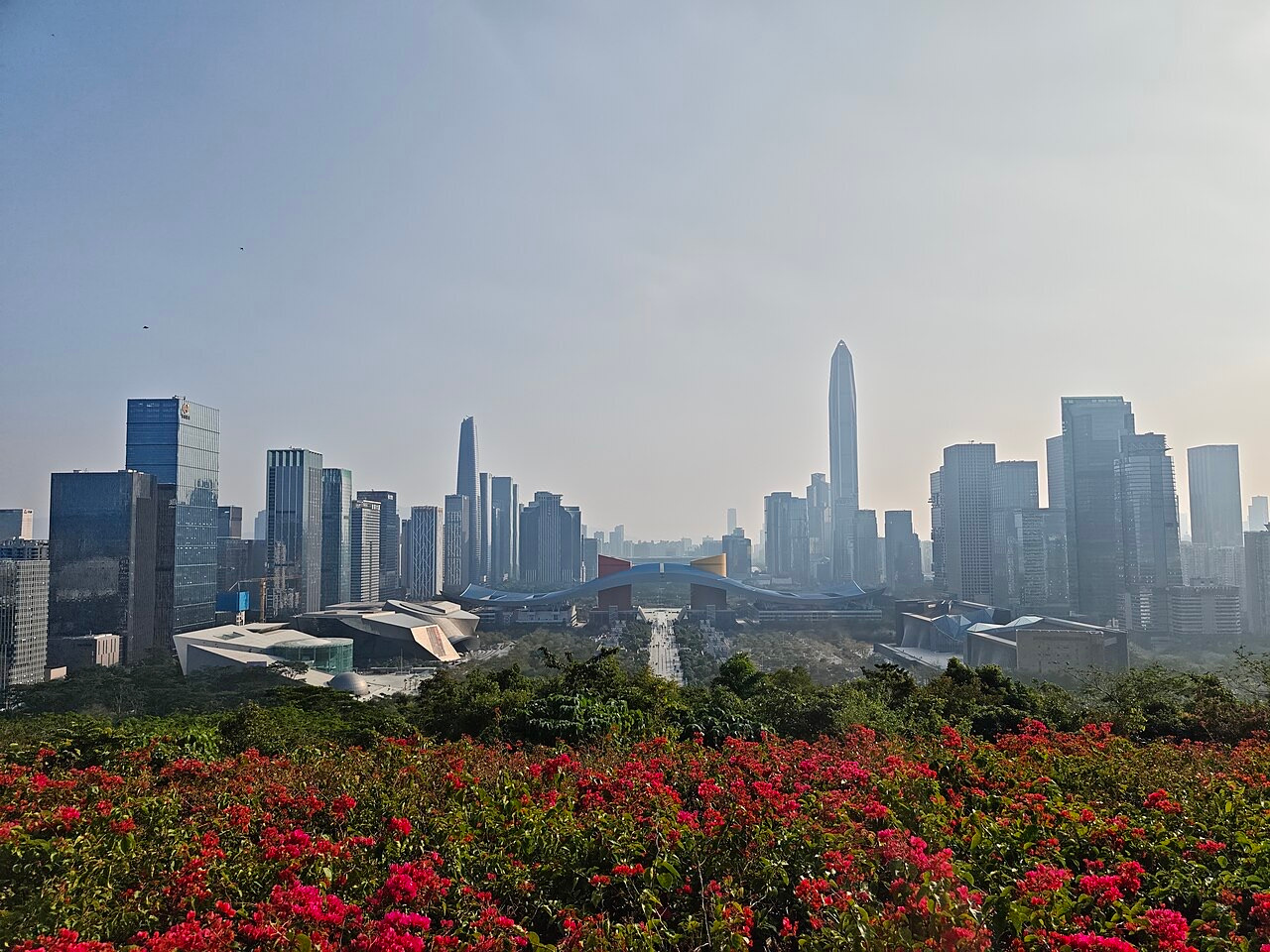
Parco centrale con una collina dolce e un punto panoramico sullo skyline di Futian.
≈ 2 h
Villaggio dei dipinti a olio di Dafen
Quartiere di pittori con atelier e laboratori di riproduzioni artistiche; visitatelo con i vostri tempi.
≈ 2 h
Window of the World
Parco a tema con miniature dei monumenti del mondo; l’area è ampia, quindi procedete con calma.
≈ 4 h